


Cost control is usually associated with spending less. In complex industrial projects, however, reducing preventive activities can have the opposite effect.
Engineering reviews, supplier follow-up, inspections, expediting, logistics controls and material-receiving checks all require investment. Their value can be difficult to demonstrate because the problems they prevent never become visible. The cost of insufficient intervention may emerge only later—during manufacturing, delivery, construction or commissioning—when corrective action is significantly more expensive.
The relevant management question is therefore not whether preventive controls cost money. It is where early intervention is economically justified and where the cost of doing nothing is likely to be greater.
Not Every Supply Requires the Same Level of Control
Applying the same controls to every purchase order would be expensive and inefficient. Applying them too selectively, without a consistent method, can leave projects exposed to avoidable failures.
Criticality cannot be determined by equipment value alone. A relatively low-value component may still interrupt construction, delay commissioning or prevent a larger system from operating. Conversely, expensive equipment does not automatically require every available control if the design is mature, the supplier has a strong record and the consequences of failure are manageable.
A meaningful assessment therefore combines technical and operational criticality, engineering complexity, historical non-conformities, supplier performance, project and purchase-order value, logistics exposure and the consequences of discovering a problem only after delivery or at site.
Learning from Historical Failures
A multi-year analysis of project and non-conformity data was used to understand where the organization had previously lost value.
Equipment and supply categories were compared according to the number of recorded events, their total financial impact and the average cost of each occurrence. This distinguished frequent lower-cost problems from less common failures with potentially significant consequences.
Combining frequency, total exposure and average impact produced a more balanced view of where preventive investment could create value.
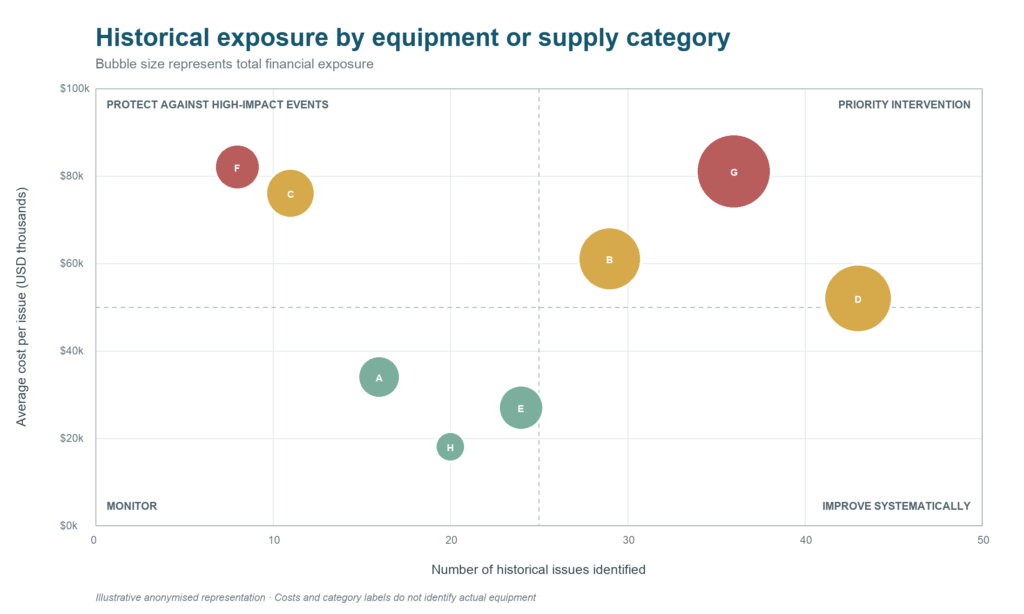
Illustrative anonymised representation — costs and category labels do not identify actual equipment.
From Analysis to a Criticality Framework
The historical analysis was translated into a common criticality framework applicable at business-unit, project and purchase-order level.
The framework supported decisions on engineering review, supplier follow-up, inspection, expediting, logistics controls, preservation requirements and verification at material receipt. It also created a common basis for engineering, procurement, quality, logistics and site teams to evaluate exposure together.
Investing Where It Matters
The resulting business case compared the estimated cost of preventive intervention with the historical exposure associated with non-conformities, rework and problems discovered after delivery.
The analysis indicated that targeted intervention could create a potential six-figure net benefit for an applicable project and protect multi-million value across a wider portfolio. The potential included reduced rework, fewer site disruptions, earlier resolution of engineering and manufacturing issues and more effective use of specialist resources. Actual benefits remained subject to implementation and operational validation.
A Different View of Cost
The objective is not to inspect everything, add controls indiscriminately or eliminate every possible failure. It is to use evidence to decide where intervention can materially reduce exposure, which control is appropriate, when action can still influence the outcome and whether the expected benefit justifies the investment.
Outcome
Spending more at the right time is not an extra cost. It is a deliberate decision to avoid spending substantially more later.

