

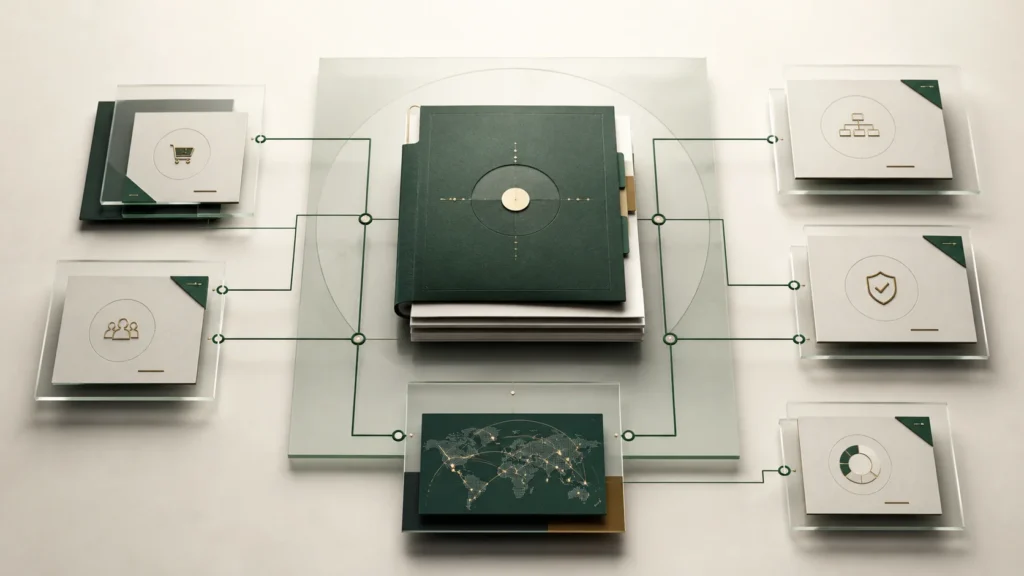
Back-to-back contracting is often understood as the transfer of obligations from a customer contract into purchase orders and subcontracts. In practice, effective contractual alignment requires more than replicating clauses across documents.
Customer commitments must be interpreted, allocated to the parties capable of managing them and adapted to each downstream scope. Obligations that cannot be transferred must remain visible, quantified and actively managed within the business.
The objective is not simply to create stronger contracts. It is to establish an integrated framework that protects value across the full contracting chain.
The Hidden Cost of Fragmented Contracting
Large project organisations rarely operate without contractual templates. The challenge is more often the number, age and fragmentation of the documents already in use.
General terms may have been developed locally many years earlier and progressively modified for individual projects or negotiations. Business units, countries and disciplines may therefore use different positions for comparable scopes, without a common view of which clauses or deviations have historically generated claims or loss of value.
The exposure often becomes visible only during execution, when a delay, defect or dispute reveals that an upstream obligation is not supported by an equivalent downstream entitlement. Similar gaps may arise in liabilities, warranties, insurance, remedies and delivery responsibilities.
Connecting the Contracting Chain
An integrated review begins with the customer contract. Schedule commitments, Liquidated Damages, performance requirements, warranties, indemnities, insurance, securities, change procedures and termination rights must be assessed according to who controls the underlying risk.
For each material obligation, the organisation should determine whether it belongs in a purchase order, a subcontract or both; whether it can be transferred or must be adapted; and how retained exposure will be mitigated, priced or approved. This connects the customer commitment, the internal risk position and the conditions applied downstream.
Purchase Orders: Protecting Value in the Supply Chain
Purchase orders require a framework tailored to supply-chain risk. Delivery, technical compliance, inspection, documentation, warranties, defects, replacement, transportation and supplier delay should reflect the consequences that a failure could create for the wider project.
A common purchasing baseline can be combined with modular provisions linked to the value, complexity and criticality of the supply. This avoids imposing the same contractual burden on every purchase while ensuring that higher-risk equipment receives appropriate protection before the order is placed.
Subcontracts: Aligning Site Execution Obligations
Civil, piping, mechanical, electrical, instrumentation and commissioning activities interact directly with schedule, site interfaces, safety, testing and handover. The subcontract framework must connect obligations assumed towards the client with activities controlled by each subcontractor.
Common General Terms and Conditions can establish the business-unit position, while discipline-specific modules and project amendments address the characteristics of each package. Schedule obligations, change procedures, warranties, liabilities, indemnities and delay consequences can then be transferred where appropriate and proportionate to the subcontracted scope.
Insurance as a Practical Example
Insurance demonstrates why contractual alignment cannot be achieved through automatic flow-down. The customer contract may require specific policies, limits, periods of cover and insured parties. Some risks may already be covered through corporate or project-wide insurance, while others must be supported by suppliers or subcontractors.
An effective framework maps client requirements, insurance retained by the main contractor, policies required downstream, and the related limits, deductibles and renewal requirements. A subcontractor and an equipment supplier do not necessarily require the same provisions: the obligation should follow the risk, not simply repeat upstream wording.
From Templates to Contract Governance
The output should be a controlled system comprising standard positions, customer-contract risk assessment, purchasing and subcontracting terms, scope-specific modules, a back-to-back obligations matrix, negotiation fallbacks, deviation approval and clear functional ownership.
Claims, non-conformities and project lessons learned should feed back into the framework. This allows standardisation where consistency creates value while retaining the flexibility required for different projects, jurisdictions, scopes and counterparties.
Outcome
An integrated framework can reduce repeated drafting, shorten negotiation cycles and make contractual deviations more visible across the portfolio. As an initial business-case assumption, wider implementation could target a 20-30% reduction in recurring deviations and a 15-25% improvement in contract-preparation and negotiation time. These ranges require validation against portfolio data and implementation maturity.
The more significant benefit is improved alignment of liabilities, remedies, insurance and execution obligations across the contracting chain. Transferable risks are allocated to the parties best positioned to manage them; retained risks become visible, enabling management to price, mitigate or approve them consciously.
The result is not simply a more consistent set of contracts. It is a scalable contract-governance model that helps protect margin, improve accountability and reduce non-recoverable exposure across the project portfolio.


